
Endless hot water on demand. No tank to fill, no standby heat loss. Here's everything you need to know about how tankless water heaters work and why so many homeowners are making the switch.
We install tankless water heaters throughout Grand Rapids and West Michigan.
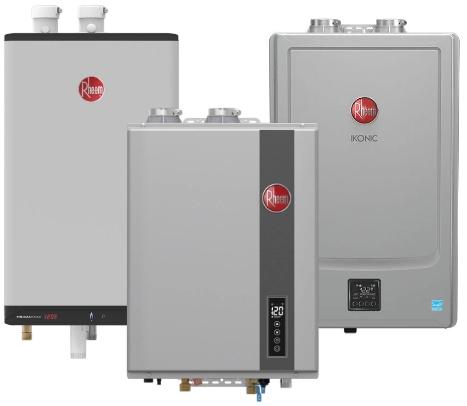
A tankless water heater - also called an on-demand water heater - heats water as you need it, rather than storing a large tank of pre-heated water. There's no tank to fill, no standby heat loss, and no limit to how much hot water you can use at once.
The unit mounts to the wall and takes up a fraction of the space of a conventional water heater. It runs on the natural gas or propane already connected to your home, and it only fires when you actually turn on a hot tap.
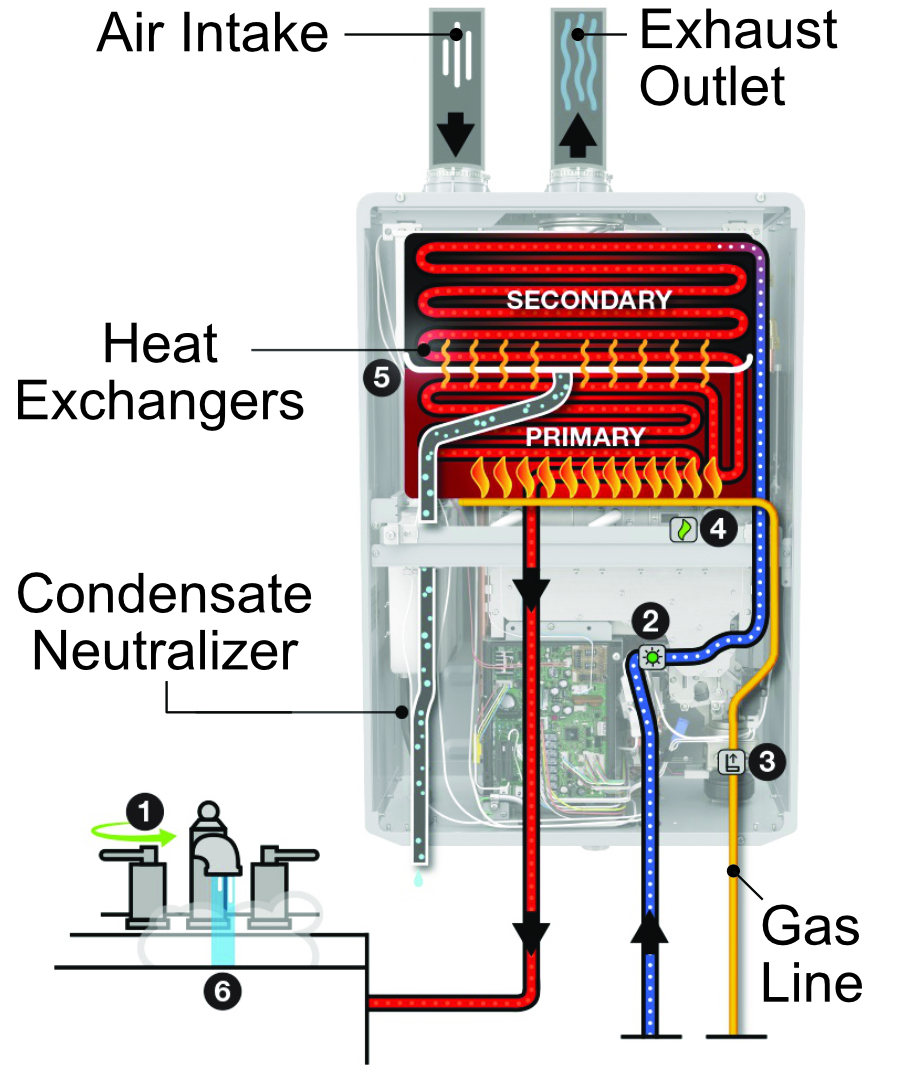
How It Works
A hot water faucet is opened
Opening any hot tap starts the water flowing through the unit and wakes it from its ready state.
The flow sensor activates the exhaust fan
Cold water entering the unit passes over the flow sensor, which triggers unit activation at just 0.4 GPM. Water then flows through the secondary heat exchanger and into the primary. The combustion fan also activates to prep the burner system. It draws in fresh air from outside through closed vent piping and exhausts the flue gases through a separate, sealed exhaust pipe.
Gas is delivered to the burners
The gas valve opens and sends fuel to the burners inside the unit, readying them for ignition.
Ignitors spark and combustion begins
Ignitors in the unit spark, gas ignites, and the burners begin heating the water flowing through the heat exchangers.
Heat is extracted and condensate is neutralized
Heat from the flame transfers to water in the primary heat exchanger; residual heat is captured in the secondary. Because so much heat is pulled from the combustion gases, acidic condensation forms - it passes through a built-in condensate neutralizer before safely draining.
Hot water exits the faucet
Hot water travels to the open faucet. When the tap closes, the flow sensor stops and the unit goes into a ready state. Rheem's HotStart Programming™ minimizes cold-water bursts if the faucet is reopened within five minutes.
A tankless water heater isn't just a newer version of the same thing - it's a fundamentally different approach to hot water that solves real problems.
No tank means no limit. Hot water keeps flowing whether it's the first shower of the morning or the fifth. Great for larger families, frequent guests, or anyone who's ever been left with a cold rinse.
A traditional tank keeps water hot around the clock - even at 3am when nobody's using it. A tankless unit only fires when you actually need hot water. That difference in standby energy waste shows up on your gas bill every month.
A quality tankless unit lasts roughly twice as long as a conventional water heater. That means fewer replacements over your lifetime in the home, and more time between the disruption and expense of a new install.
Tankless units are wall-mounted and compact - about the size of a small suitcase. Switching from a 50-gallon tank gives back a meaningful chunk of floor space in your utility room, basement, or closet.
When a conventional tank fails, you usually replace the whole unit. Tankless water heaters are designed with individually replaceable components - a worn igniter, a failing sensor, a scale-damaged part can all be swapped out without scrapping the entire system.
The upfront cost is higher than a straight tank swap. But when you factor in lower operating costs, a longer lifespan, and fewer replacement cycles over 20+ years, the math usually favors tankless for homeowners who plan to stay in their home.
Compared to a conventional storage tank, a properly installed tankless water heater eliminates several of the most common household safety risks associated with water heating.
No Risk of Carbon Monoxide Entering Your Home
Modern tankless water heaters use sealed, direct-vent combustion. Outside air is drawn in through a dedicated intake pipe and exhaust exits through a separate sealed flue - completely isolated from your living space. Combustion gases never mix with the air in your home.
No Tank to Rupture, Leak, or Flood Your Basement
A failing 50-gallon storage tank can release hundreds of gallons of water before anyone notices - enough to cause serious structural damage. Without a tank, that risk doesn't exist. There's no standing water stored under pressure, and nothing to corrode from the inside out.
Built-In Safeties That Actively Protect Your Home
Rheem tankless units include multiple layers of automated protection: overheat shutoff, flame failure detection, freeze protection, and abnormal flow detection. If something goes wrong, the unit shuts itself down and displays an error code - rather than continuing to run in a potentially unsafe state.
Water Leak Alarm & Drain Pan Included with Every Install
Every installation includes a drain pan beneath the unit and a water leak alarm that alerts you immediately if any moisture is detected. Even without a tank, connections can develop drips over years of use - you'll know about it right away rather than discovering damage later.
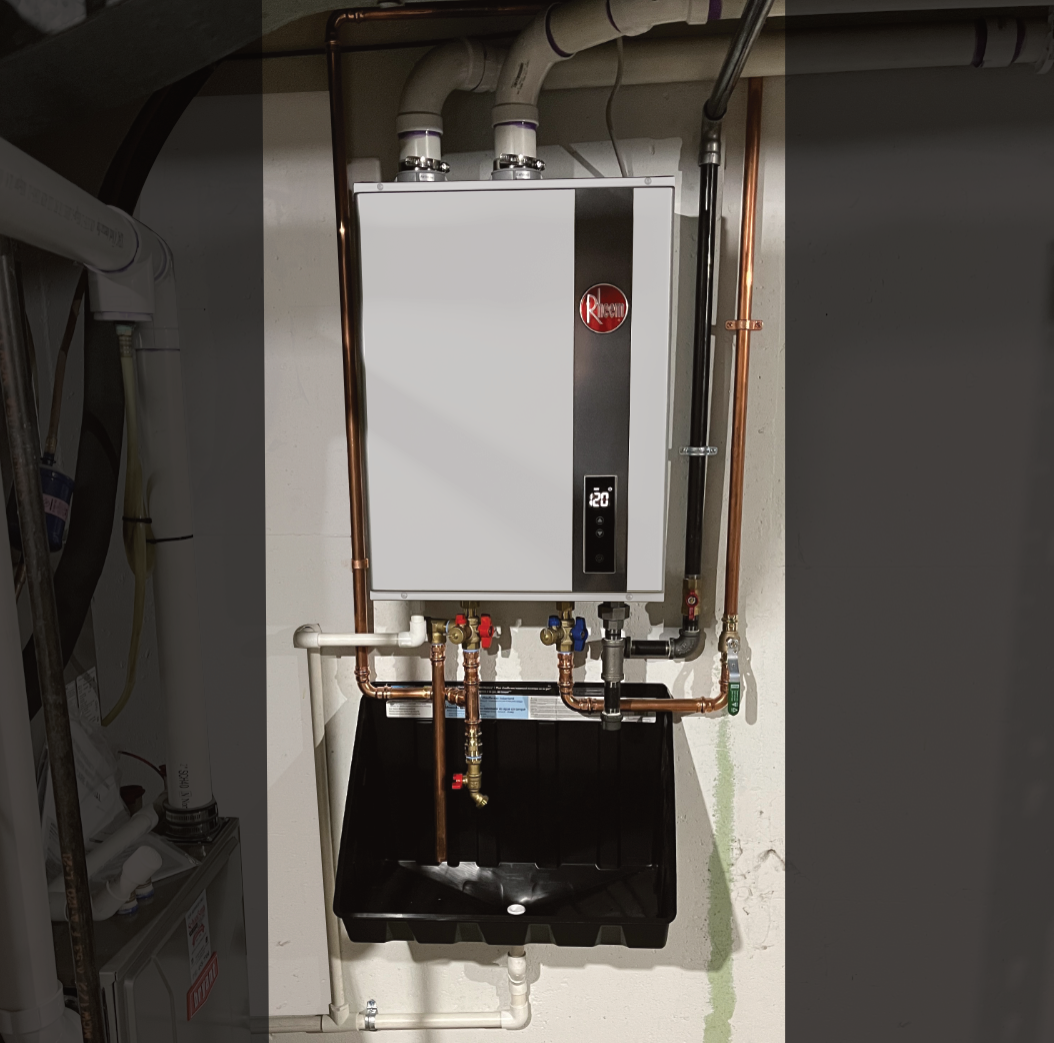
A tankless water heater can be the right choice for many homes, but there are a few things worth understanding before you commit.
The upfront cost is higher than a tank replacement
Tankless units cost more to purchase and install than a conventional water heater - sometimes significantly more if your gas line needs to be updated. That said, lower operating costs and a longer lifespan often offset the difference over time.
Your existing gas line may need to be upsized
Tankless units require a higher gas flow than a conventional water heater. When we come out for an assessment, we check your gas line and let you know upfront if an upgrade is needed and what it'll cost - before you commit to anything.
Annual descaling keeps it running at its best
West Michigan water is hard. Minerals in the water deposit inside the unit over time, and if left unchecked they reduce efficiency and shorten the unit's lifespan. Descaling once a year - a 45-minute process - is the most important maintenance task for a tankless water heater.
You may occasionally notice a brief burst of lukewarm water
Known as the 'cold water sandwich,' this happens when you turn on a hot tap for a few seconds, turn it off, and turn it on again shortly after. A small amount of lukewarm water can appear before the unit re-fires. It's a minor quirk and most households stop noticing it quickly.
Whole-home electric tankless isn't a practical option for most homes
Electric tankless water heaters for whole-home use require enormous electrical capacity - often more than a typical home's entire panel. For homes without gas or propane, a heat pump water heater is usually the better path. We install gas and propane tankless only.
Have questions? Give us a call. We'll give you a straight answer about whether tankless makes sense for your home.
A properly installed tankless water heater will typically last 20–25 years - roughly double the lifespan of a storage tank. The key difference is that major components (heat exchanger, flow sensor, igniter, control board) are individually replaceable, so you're never forced to replace the entire unit for a single failed part.
The biggest threat to lifespan in West Michigan is scale buildup. Our water is hard - mineral deposits accumulate inside the heat exchanger over time, reducing efficiency and eventually causing damage if left unchecked. Annual descaling (also called flushing) is the single most important maintenance task for a tankless unit.
Descale (flush) the heat exchanger using a descaling solution to remove mineral buildup. Takes about 45–60 minutes. This is the most important maintenance task for longevity.
Check the inline filter screen on the cold water inlet for debris and rinse it clean. Takes 5 minutes.
Inspect the venting connections for any signs of corrosion, disconnection, or blockage - especially after harsh winters.
Have a technician inspect the igniter, flame sensor, and flow sensor. These components wear gradually and are inexpensive to replace proactively.
Pay attention to error codes on the unit display. Most codes are minor and easy to address - ignoring them leads to bigger problems.
What's the real cost of ownership?
Tankless units cost more upfront but less per year to operate because of their energy efficiency. They only fire when hot water is called for, which eliminates the standby heat loss you pay for around the clock with a tank. Over 20+ years, the lower operating cost often offsets the higher installation price - especially for high-use households.
Signs your tankless unit needs service:
One price covers everything below - no line-item surprises, no addons.
New Tankless Water Heater
Brand new, professional grade, Rheem tankless water heater sized for your home's demand.
2-Year Craftsmanship Guarantee
We’re professionals in our field, but we’re also human. If we make a mistake on your installation, we take full responsibility and will come back to fix it at no charge.
One Price, Zero Surprises
No additional fees, addons, or upsells. All parts & labor included - removal of old unit, installation, connections, testing - for one price.
100% Satisfaction Guarantee
We stay until the job is finished, your questions are answered and you feel confident using your new system.
Also included - every time
Trusted by homeowners in Grand Rapids and across West Michigan.
“Immediate and professional response. Did not try to oversell, merely met my needs and verified functionality thoroughly.”
- Allison K., Grand Rapids
“Efficient, friendly, and fair.”
- Sue M., Grand Rapids
“Very easy to work with, great quality, stuck to estimates, very professional, no bs.”
- John S., Dorr
“Great customer service. Did all work quickly and professionally. They cleaned up afterward and even replaced custom insulation.”
- Eric V., Holland
“Showed up on time, knew what he was doing, got the job done quickly, on budget and completely.”
- Dane B., Ada
“Took the time to educate us so we could be empowered, not overpowered. I want you to know how impressed I was by his integrity.”
- Laura B., Hudsonville
You can compare prices using our Exact Quote Tool to see the real installed cost for your specific home and preferences. Tank water heaters typically have a lower upfront cost, with most installations in the $1,500–$2,995 range depending on size and fuel type. Tankless units generally start around $3,995 installed, largely due to the additional labor for venting and gas line upgrades. However, tankless units can save money over time through energy efficiency and longer lifespan.
It depends on your home's existing gas line size and venting setup. Tankless units draw significantly more BTUs than a tank and often require a larger-diameter gas line and a new venting run. In some homes this is straightforward; in others it requires more prep work. We assess your setup before committing to a timeline and will tell you exactly what's needed.
Whole-home electric tankless units require 150–200+ amps of dedicated service, more than most homes have in their entire electrical panel. The installation cost of upgrading your service to accommodate one typically far exceeds the cost of a gas tankless unit. We install gas and propane tankless only. If your home is all-electric and you want on-demand performance, call us - we can talk through the options.
It's a real but minor quirk. When you turn on a hot tap briefly, turn it off, and then turn it back on shortly after, a small slug of cold water can emerge before the hot arrives. This happens because residual warm water in the pipe is followed by a momentary burst of cold water before the unit re-fires and heats the new flow. Most households adapt to it quickly, and it's most noticeable on short back-to-back draws.
In West Michigan, yes - annual descaling is strongly recommended. Our water is hard, meaning it carries dissolved minerals (primarily calcium and magnesium) that deposit inside the heat exchanger over time. If left unchecked, scale buildup reduces efficiency and can cause the unit to overheat and fail prematurely. Annual flushing with a descaling solution takes under an hour and keeps the unit running at peak efficiency.
A straight swap - replacing an existing tankless unit with a new one on the same venting and gas line - typically takes 3–4 hours. A conversion from tank to tankless is more involved: expect a half-day to full day depending on what gas line and venting work is needed. We'll give you an accurate estimate before we start.
Yes. A mechanical permit is required for all water heater installations in Grand Rapids and most West Michigan municipalities. We pull the permit and schedule the inspection as part of every job - it's included in your price. Any contractor who skips the permit to save time is putting you at risk: uninspected work can create liability issues when you sell your home.
Get your exact installed price in 30 seconds - or call us and we'll walk you through whether tankless is the right move for your home.